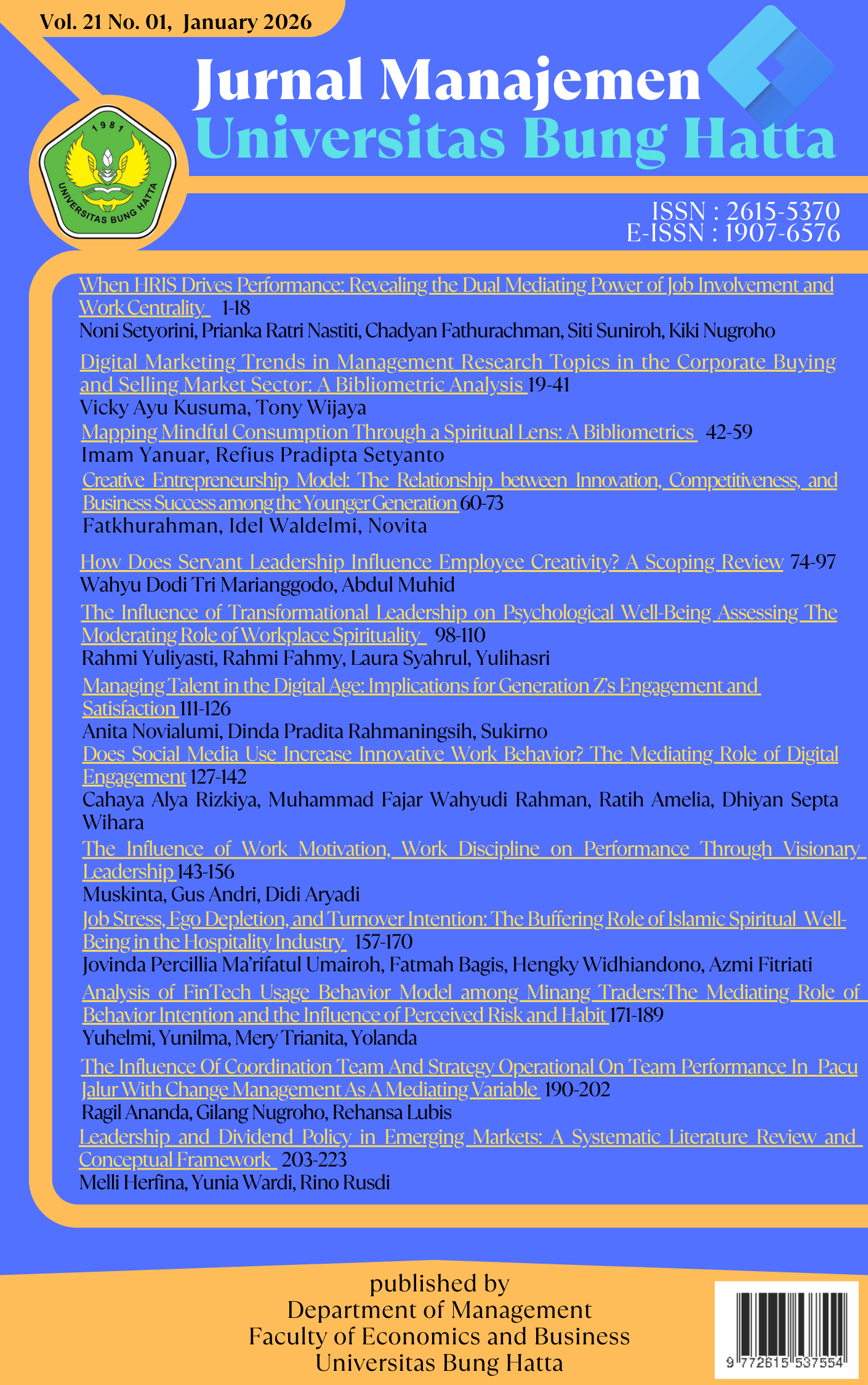
Job Stress, Ego Depletion, and Turnover Intention: The Buffering Role of Islamic Spiritual Well-Being in the Hospitality Industry
DOI:
https://doi.org/10.37301/jmubh.v21i1.29122Abstract
High levels of work stress and employee turnover are classic problems in the hospitality industry that have serious implications for organizational sustainability. This study aims to analyze the effect of work stress on turnover intention through ego depletion, as well as test the role of Islamic Spiritual Well-Being (ISWB) as a moderation variable. This research is based on the Conservation of Resources (COR) Theory which emphasizes the importance of psychological resources in dealing with work pressure. The research population included 970 hotel and restaurant employees in the Purwokerto area, with a sample of 210 respondents selected using stratified random sampling techniques. The data was analyzed using Partial Least Squares-Structural Equation Modeling (PLS-SEM). The results of the study show that work stress has a positive effect on turnover intention both directly and indirectly through ego depletion. ISWB has been shown to moderate the relationship between work stress and turnover intention, where employees with high levels of Islamic spirituality show a lower tendency to leave work despite facing high stress. This research expands the application of COR Theory in the context of hospitality and makes a practical contribution to hotel and restaurant management in designing stress management programs based on Islamic spirituality.
References
Ahmad, A. F. (2022). The Influence of Interpersonal Conflict , Job Stress , and Work Life Balance on Employee Turnover Intention. Journal of Humanities and Education Development (JHED), 4(2). https://doi.org/10.22161/4.2.1
Akdemir, M. A. (2022). Job Stress and Turnover Intention in The Hotel Employees. Journal of Tourism and Gastronomy Studies, 10(1), 1–10. https://doi.org/10.21325/jotags.2022.973
Amiruddin, A., Qorib, M., & Zailani, Z. (2021). A study of the role of Islamic spirituality in happiness of Muslim citizens. HTS Teologiese Studies / Theological Studies, 77(4), 1–5. https://doi.org/10.4102/hts.v77i4.6655
Bagis, F., & Adawiyah, W. R. (2025). Divine Guidance in The Face of Toxicity: How Islamic Leadership Navigates Workplace Stress and Mental Wellbeing in Higher Education Institutions. MIX: Jurnal Ilmiah Manajemen, 15(2), 31–43. https://doi.org/http://dx.doi.org/10.22441/jurnal_mix.2025.v15i2.004
Bagis, F., Adawiyah, W. R., Purnomo, R., & Sudjadi, A. (2024). Exploring Islamic Spiritual Well-Being: Conceptualization and Validation of a Measurement Scale. Islamic Guidance and Counseling Journal, 7(2). https://doi.org/10.25217/0020247473500
Bagis, F., Adawiyah, W. R., Tubastuvi, N., & Dumasari, D. (2025). Islamic Spiritual Well-Being in the Workplace: Leadership, Ethics, and the Prevention of Deviant Behavior. Ganesha Kreasi Semesta.
Bagis, F., Adawiyah, W. R., Tubastuvi, N., & Umairoh, J. P. M. (2025). Beyond Religion : Applying Islamic Spiritual Well-Being to Improve Ethical Behavior in Modern Organizations. Journal of Cultural Analysis and Social Change, 10(2), 2030–2039.
Bagis, F., Adawqiyah, W. R., & Purnomo, R. (2025). The Power of Islamic Spirituality in Diminishing Darkness of Job Stress , Ego Depletion and Cyberloafing Diversion in the Islamic Workplace Culture. Management And Accounting Review, 24(3).
Baumeister, R. F. (2002). Ego Depletion and Self-Control Failure: An Energy Model of the Self’s Executive Function. Self and Identity, 1(2), 129–136. https://doi.org/10.1080/152988602317319302
Baumeister, R. F., Bratslavsky, E., Muraven, M., & Tice, D. M. (1998). Ego depletion: Is the active self a limited resource? Self-Regulation and Self-Control: Selected Works of Roy F. Baumeister, 74(5), 16–44. https://doi.org/10.4324/9781315175775
Bufquin, D., Park, J. Y., Back, R. M., de Souza Meira, J. V., & Hight, S. K. (2021). Employee work status, mental health, substance use, and career turnover intentions: An examination of restaurant employees during COVID-19. International Journal of Hospitality Management, 93(December 2020), 102764. https://doi.org/10.1016/j.ijhm.2020.102764
Charzyńska, E., Polewczyk, I., Góźdź, J., Kitlińska-Król, M., & Sitko-Dominik, M. (2021). The buffering effect of spirituality at work on the mediated relationship between job demands and turnover intention among teachers. Religions, 12(9). https://doi.org/10.3390/rel12090781
Chin, W. W. (2010). Handbook of Partial Least Squares. Handbook of Partial Least Squares, November 2010. https://doi.org/10.1007/978-3-540-32827-8
Dang, J. (2018). An updated meta-analysis of the ego depletion effect. Psychological Research, 82(4), 645–651. https://doi.org/10.1007/s00426-017-0862-x
Darmawan dan, & Bagis. (2024). Effort To Prevent and Reduce Employee Turnover Intention in the Hospitality. Revista de Gestao Social e Ambiental, 18(5), 1–18. https://doi.org/10.24857/rgsa.v18n5-028
Dodanwala, T. C., Santoso, D. S., & Yukongdi, V. (2023). Examining work role stressors, job satisfaction, job stress, and turnover intention of Sri Lanka’s construction industry. International Journal of Construction Management, 23(15), 2583–2592. https://doi.org/10.1080/15623599.2022.2080931
Elshaer, I. A., Azazz, A. M. S., Alyahya, M., Mohammad, A. A. A., Fayyad, S., & Elsawy, O. (2025). Emotional Contagion in the Hospitality Industry : Unraveling Its Impacts and Mitigation Strategies Through a Moderated Mediated PLS-SEM Approach. Lmx, 1–24.
Ertemsir, E., Bal, Y., Demirhan, A., & Kökalan, Ö. (2024). The moderating role of workplace spirituality on the effect of organizational justice on job satisfaction. Frontiers in Psychology, 15(August), 1–13. https://doi.org/10.3389/fpsyg.2024.1360913
Ferdian, A., Luturlean, B. S., Zhafira, K. D., & Izumi, N. K. (2020). The Impact of Work Stress on Turnover Intention in Indonesia: Is There A Mediation from Employee’ Job Satisfaction? GATR Journal of Management and Marketing Review, 5(1), 31–40. https://doi.org/10.35609/jmmr.2020.5.1(3)
Hair, J. F., Hult, G. T. M., Ringle, C. M., Sarstedt, M., Danks, N. P., & Ray, S. (2021). Partial Least Squares Structural Equation Modeling (PLS-SEM) Using R. In Practical Assessment, Research and Evaluation (Vol. 21, Issue 1).
Hair, J. F., Risher, J. J., Sarstedt, M., & Ringle, C. M. (2019). When to use and how to report the results of PLS-SEM. European Business Review, 31(1), 2–24. https://doi.org/10.1108/EBR-11-2018-0203
He, C., & Wei, H. (2022). Negative workplace gossip and turnover intention among Chinese rural preschool teachers: The mediation of ego depletion and the moderation of bianzhi. Frontiers in Psychology, 13(December), 1–11. https://doi.org/10.3389/fpsyg.2022.1034203
He, C., Xiong, J., Zhang, Y., Dou, H., & Du, J. (2023). Destructive Leadership and Turnover Intention among Chinese Rural Kindergarten Teachers: The Mediation of Ego Depletion and the Moderation of Kindergarten Affiliation. International Journal of Environmental Research and Public Health, 20(3). https://doi.org/10.3390/ijerph20032030
Hobfoll, S. E. (2001). The Influence of Culture, Community, and the Nested-Self in the Stress Process: Advancing Conservation of Resources Theory. Applied Psycholog: An International Review, 50(3), 337–421. https://doi.org/10.1007/978-981-97-7874-4_1210
Hobfoll, S. E., Halbesleben, J., Neveu, J.-P., & Westman, M. (2018). Conservation of Resources in the Organizational Context: The Reality of Resources and Their Consequences. Annual Review of Organizational Psychology and Organizational Behavior, 5, 103–131. https://doi.org/https://doi.org/10.1146/annurev-orgpsych- 032117-104640
Hwang, E. R., & Yi, Y. (2022). Workplace spirituality and organizational justice in turnover intention of mental health professionals at small‐sized centres. Journal of Nursing Management, 30(1), 328–335. https://doi.org/doi.org/10.1111%2Fjonm.13459
Isikan, S. (2024). ISLAMIC FAITH AS A SOURCE OF COPING WITH. 62(1), 65–90. https://doi.org/10.14421/ajis.2024.621.65-90
Jackson, D., Shan, H., & Meek, S. (2022). Employer development of professional capabilities among early career workers and implications for the design of work-based learning. International Journal of Management Education, 20(3), 100692. https://doi.org/10.1016/j.ijme.2022.100692
Jin, D. (2023). Devils at job environment: A study on employee ego depletion from abusive supervision and workaholic coworker. International Journal of Hospitality Management, 114(August), 103586. https://doi.org/10.1016/j.ijhm.2023.103586
Jones, C., White, L., & Pluquailec, J. (2024). Hospitality Work as Social Reproduction : Embodied and Emotional Labour during. https://doi.org/10.1177/00380385231189190
Jung, M. K., Jung, T. G., Jeon, M. W., & Lee, J. H. (2024). The structural relationship of job stress, job satisfaction, organizational commitment, and turnover intention among youth sports education leaders in Korea. Frontiers in Psychology, 15(November), 1–10. https://doi.org/10.3389/fpsyg.2024.1385993
Khoirunnisa, N. Z. (2025). The Effect of Workload and Job Stress on Turnover Intention of Employees. Applied Social Psychology Studies (ASPS), 1(1), 40–53.
Kim, H., & Kim, E. G. (2021). A meta-analysis on predictors of turnover intention of hospital nurses in South Korea (2000–2020). Nursing Open, 8(5), 2406–2418. https://doi.org/10.1002/nop2.872
Maharani, A., & Tamara, D. (2024). SA Journal of Human Resource Management. SA Journal of Human Resource Management, 1–10. https://doi.
Mobley, W. H. (1977). Intermediate linkages in the relationship between job satisfaction and employee turnover. Journal of Applied Psychology, 62(2), 237–240. https://doi.org/10.1037/0021-9010.62.2.237
Ning, L., Jia, H., Gao, S., Liu, M., Xu, J., Ge, S., Li, M., & Yu, X. (2023). The mediating role of job satisfaction and presenteeism on the relationship between job stress and turnover intention among primary health care workers. International Journal for Equity in Health, 22(1), 1–11. https://doi.org/10.1186/s12939-023-01971-x
Oh, J., & Wang, J. (2020). Spiritual leadership: Current status and Agenda for future research and practice. Journal of Management, Spirituality and Religion, 17(3), 223–248. https://doi.org/10.1080/14766086.2020.1728568
Parker, D. F., & DeCotiis, T. A. (1983). Organizational Detrminants of Job Stress. Organizational Behavior and Human Performance, 32, 160–177. https://doi.org/10.4324/9780203813140
Pramudita, D. P. D., Mayasari, A., & Almoza, F. M. L. (2025). Job Stress, Job Burnout, and Turnover Intention in Employees of Digital Education Platform and Book Provider Company PT. XYZ. International Journal of Economics and Management Research, 4(2), 646–654. https://doi.org/10.55606/ijemr.v4i2.444
Putri, D. N., Bagis, F., Tubastuvi, N., & Widhiandono, H. (2023). Understanding Turnover Intention: Exploring the Influence of Job Security, Perceived Organizational Support, and Job Satisfaction as a Mediator. International Journal of Scientific Research and Management (IJSRM), 11(12), 5614–5630. https://doi.org/10.18535/ijsrm/v11i12.em11
Salama, W., Abdou, A. H., Mohamed, S. A. K., & Shehata, H. S. (2022). Impact of Work Stress and Job Burnout on Turnover Intentions among Hotel Employees. International Journal of Environmental Research and Public Health, 19(15). https://doi.org/10.3390/ijerph19159724
Sugiyono. (2017). Metode penelitian kuantitatif, kualitatif dan R & D. Alfabeta.
Suroya, A. F., Bagis, F., Widhiandono, H., & Rahmawati, I. Y. (2023). Examining the Influence of Transformational Leadership and Job Satisfaction to Reduce Turnover Intention with Organizational Commitment as a Mediator. Asian Journal of Economics, Business and Accounting, 23(24), 124–140. https://doi.org/10.9734/ajeba/2023/v23i241192
Syahir, A. N. A., Abidin, M. S. Z., Sa’ari, C. Z., & Rahman, M. Z. A. (2025). Workplace Spirituality and Its Impact on Employee Well-Being: A Systematic Literature Review of Global Evidence. In Journal of Religion and Health (Issue 0123456789). Springer US. https://doi.org/10.1007/s10943-025-02350-2
Taylor, E. J., Morrell, H. E. R., Ada, H. M., Dupée, C., Jordan, M., Radovich, P., & Boyd, K. C. (2024). Do nurse spiritual responses to trauma explain nurse outcomes? A correlational observational study. Nursing Outlook, 72(6), 102296. https://doi.org/10.1016/j.outlook.2024.102296
Tett, R. P., & Meyer, J. P. (1993). Job Satisfaction, Organizational Commitment, Turnover Intention, and Turnover: Path Analyses Based on Meta‐Analytic Findings. Personnel Psychology, 46(2), 259–293. https://doi.org/10.1111/j.1744-6570.1993.tb00874.x
Twenge, J. M., Zhang, L., & Im, C. (2004). It’s beyond my control: A cross-temporal meta-analysis of increasing externality in locus of control, 1960-2002. Personality and Social Psychology Review, 8(3), 308–319. https://doi.org/10.1207/s15327957pspr0803_5
Üngüren, E., Onur, N., Demirel, H., & Tekin, Ö. A. (2024). The Effects of Job Stress on Burnout and Turnover Intention: The Moderating Effects of Job Security and Financial Dependency. Behavioral Sciences, 14(4). https://doi.org/10.3390/bs14040322
Xanthopoulou, D., Bakker, A. B., Dollard, M. F., Demerouti, E., Schaufeli, W. B., Taris, T. W., & Schreurs, P. J. G. (2007). When do job demands particularly predict burnout? The moderating role of job resources. Journal of Managerial Psychology, 22(8), 766–786. https://doi.org/10.1108/02683940710837714
Xiu, J., Zheng, J., Li, Z., & Zhang, Z. (2022). An Ego Depletion Perspective Linking Political Behavior to Interpersonal Deviance. Frontiers in Psychology, 13(March), 1–10. https://doi.org/10.3389/fpsyg.2022.802636
Downloads
Published
Issue
Section
License
Copyright (c) 2026 Jovinda Percillia Ma’rifatul Umairoh, Fatmah Bagis, Hengky Widhiandono, Azmi Fitriati

This work is licensed under a Creative Commons Attribution-ShareAlike 4.0 International License.
Authors who publish with Jurnal Manajemen Universitas Bung Hatta agree to the following terms:
- Authors retain copyright and grant the journal right of first publication with the work simultaneously licensed under a Creative Creative Commons Attribution-ShareAlike 4.0 International License that allows others to share the work with an acknowledgement of the work's authorship and initial publication in Jurnal Manajemen Universitas Bung Hatta.
- The author holds the copyright of the submitted and published articles, with the understanding that articles are disseminated under the Creative Commons Attribution-ShareAlike 4.0 International License..
- The editor team is entitled to do the editing in accordance with the guidelines for writing or template in the Jurnal Manajemen Universitas Bung Hatta.
This work is licensed under a Creative Commons Attribution-ShareAlike 4.0 International License.