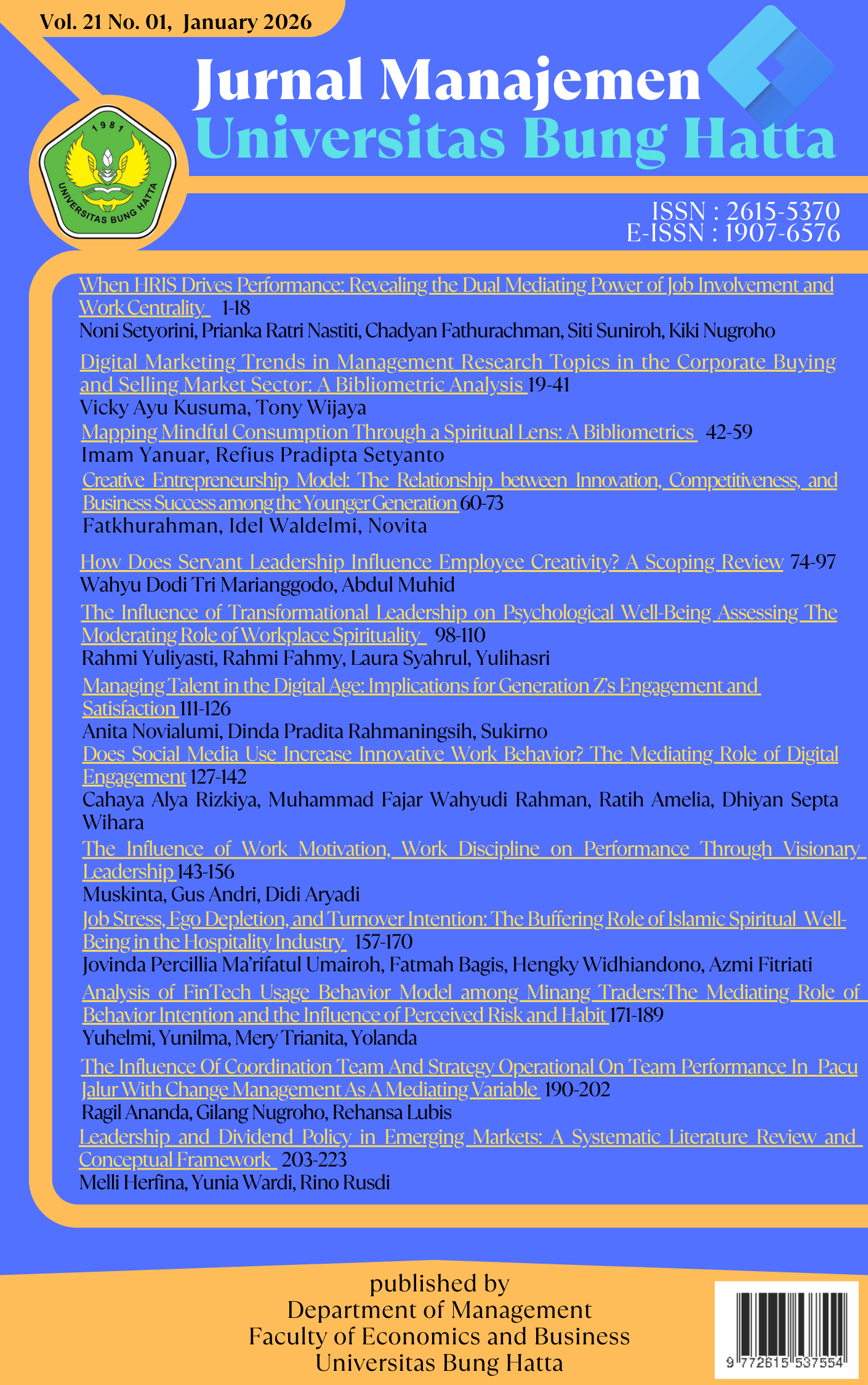
Analysis of FinTech Usage Behavior Model among Minang Traders: The Mediating Role of Behavior Intention and the Influence of Perceived Risk and Habit
DOI:
https://doi.org/10.37301/jmubh.v21i1.29131Abstract
This study examines how user behavior (UB) in financial technology transactions can help Minang traders. Factors considered include perceived ease of use (PEOU), perceived usefulness (PU), self-efficacy (SE), habits (H), perceived risk (PR), attitudes (A), and behavioral intentions (BI). The study focused on individual Minang business owners and financial operators, with a convenience sample of 178 respondents. Path analysis using SmartPLS was applied. Results show PEOU positively affects PU, but not BI directly. However, PEOU indirectly affects BI through PU, which in turn influences BI. BI does not mediate between PEOU and user behavior (UB), but PU and BI together do. Habit (H) has a positive effect on both BI and UB, and BI partially mediates the effect of H on UB. PR negatively affects UB but not BI, so BI does not mediate the PR effect on UB. However, BI does mediate the effect of PU on UB, as BI influences UB
References
Aji, H. M., Berakon, I., & Md Husin, M. (2020). COVID-19 and e-wallet usage intention: A multigroup analysis between Indonesia and Malaysia. Cogent Business and Management, 7(1). https://doi.org/10.1080/23311975.2020.1804181
Ajzen, I. (1991). The theory of planned behavior. Organizational Behavior and Human Decession Processes, 50, 179–211. https://doi.org/10.4135/9781446249215.n22
Ajzen, I. (2020). The theory of planned behavior : Frequently asked questions. April, 314–324. https://doi.org/10.1002/hbe2.195
Alalwan, A. A., Dwivedi, Y. K., Rana, N. P., & Algharabat, R. (2018). Examining factors in fluencing Jordanian customers ’ intentions and adoption of internet banking : Extending UTAUT2 with risk. Journal of Retailing and Consumer Services, 40(August 2017), 125–138. https://doi.org/10.1016/j.jretconser.2017.08.026
Alambaigi, A., & Ahangari, I. (2015). Technology Acceptance Model (TAM) As a Predictor Model for Explaining Agricultural Experts Behavior in Acceptance of ICT. International Journal of Agricultural Management and Development (IJAMAD), 6(2), 235–247.
Alkhowaiter, W. A. (2022). Use and behavioural intention of m-payment in GCC countries: Extending meta-UTAUT with trust and Islamic religiosity. Journal of Innovation and Knowledge, 7(4), 100240. https://doi.org/10.1016/j.jik.2022.100240
Amnas, M. B. (2023). Understanding the Determinants of FinTech Adoption: Integrating UTAUT2 With Trust Theoretic Model. Journal of Risk and Financial Management, 16(12), 505. https://doi.org/10.3390/jrfm16120505
Azizi, S. M., Roozbahani, N., & Khatony, A. (2020). Factors Affecting the Acceptance of Blended Learning in Medical Education: Application of UTAUT2 Model. BMC Medical Education, 20(1). https://doi.org/10.1186/s12909-020-02302-2
Bashir, I., & Madhavaiah, C. (2015). Trust, Social Influence, Self‐Efficacy, Perceived Risk and Internet Banking Acceptance: An Extension of Technology Acceptance Model in Indian Context. Metamorphosis: A Journal of Management Research, 14(1), 25–38. https://doi.org/10.1177/0972622520150105
Berakon, I., Aji, H. M., & Hafizi, M. R. (2022). Impact of digital Sharia banking systems on cash-waqf among Indonesian Muslim youth. Journal of Islamic Marketing, 13(7), 1551–1573. https://doi.org/10.1108/JIMA-11-2020-0337
Bregashtian, B., & Herdinata, C. (2021). The Effect of Perceived Ease of Use, Usefulness and Risk on Intention to Use the Go-Food Application in Surabaya and Sidoarjo. Kne Social Sciences. https://doi.org/10.18502/kss.v5i5.8807
Chen, C. F. Y., Chan, T. J., & Hashim, N. H. (2023). Factor Influencing Continuation Intention of Using Fintech from the Users’ Perspectives: Testing of Unified Theory of Acceptance and Use of Technology (UTAUT2). International Journal of Technology, 14(6), 1277–1287. https://doi.org/10.14716/ijtech.v14i6.6636
Damayanti, K. P., Lavianto, S., Agung, I. G., & Dwi, P. (2022). Analisis Behavioral Intention Dan Use Behavior Terhadap Pengguna Fintech Dana Menggunakan Metode Utaut 2. Jurnal Teknologi Komputer Dan Sistem Infomasi, 2022(5(3)), 191–199.
Davis, F. D., Bagozzi, R. P., & Warshaw, P. R. (1989). User Acceptance of Computer Technology : a Comparison of Two Theoretical Models *. Management Science, 35(8), 982–1003.
De Guinea, A. O., & Markus, L. (2009). Why break the habit of a lifetime? Rethinking the roles of intention, habit, and emotion in continuing information technology use. MIS Quarterly: Management Information Systems, 33(3), 433–444. https://doi.org/10.2307/20650303
Denovan, R. F., & Marsasi, E. G. (2025). Perceived Ease Of Use, Perceived Usefulness and Satisfaction To Maximize Behavioral Intention with The Technology Acceptance Model in Generation Y and Z Consumers. 18(1), 1–36.
Dwivedi, Y. K., Rana, N. P., Jeyaraj, A., Clement, M., & Williams, M. D. (2017). Re-examining the Unified Theory of Acceptance and Use of Technology (UTAUT): Towards a Revised Theoretical Model. Information Systems Frontiers, 1–16. https://doi.org/10.1007/s10796-017-9774-y
Han, J. H., & Sa, H. J. (2022). Acceptance of and satisfaction with online educational classes through the technology acceptance model (TAM): the COVID-19 situation in Korea. Asia Pacific Education Review, 23(3), 403–415. https://doi.org/10.1007/s12564-021-09716-7
Hasmiana, H., & Syamsuddin, F. R. (2025). The Influence of Perceived Ease of Use on Behavioral Intention Through Perceived Usefulness as an Intervening Medium in Digital Payment DANA. Jurnal Economic Resource, 7(2), 340–346. https://doi.org/10.57178/jer.v7i2.1122
Hassan, M. S., Islam, M. A., Sobhani, F. A., Nasir, H., Mahmud, I., & Zahra, F. T. (2022). Drivers Influencing the Adoption Intention towards Mobile Fintech Services: A Study on the Emerging Bangladesh Market. Information (Switzerland), 13(7), 1–16. https://doi.org/10.3390/info13070349
Hendriyawan, N. N., & Mayangsari, S. (2022). The The Influence of Perceived Usefulness, Perceived ease of use, and Perceived Risk in Using Digital Payment Services in Accounting Students. Jurnal Ekonomi Trisakti, 2(2), 611–676. https://www.e-journal.trisakti.ac.id/index.php/jet/article/download/14635/8514
Juita, V., Pujani, V., Rahim, R., & Rahayu, R. (2023). Riset Akuntansi dan Keuangan Indonesia URL : http://journals.ums.ac.id/index.php/reaksi/index Gender Differences in Financial Technology Gender Differences in Financial Technology (FINTECH) Adoption in Indonesia: An (FINTECH) Adoption in Indonesia: An Ana. JURNAL Riset Akuntansi Dan Keuangan Indonesia, 8(2). http://journals.ums.ac.id/index.php/reaksi/index
Khuong, N. V., Phuong, N. T. T., Liem, N. T., Thuy, C. T. M., & Son, T. H. (2022). Factors Affecting the Intention to Use Financial Technology among Vietnamese Youth: Research in the Time of COVID-19 and Beyond. Economies, 10(3). https://doi.org/10.3390/economies10030057
Laksamana, P. (2023). Determining factors of continuance intention in mobile payment : fintech industry perspective. 35(7), 1699–1718. https://doi.org/10.1108/APJML-11-2021-0851
Limayem, M., & Cheung, C. M. K. (2008). Understanding information systems continuance: The case of Internet-based learning technologies. Information and Management, 45(4), 227–232. https://doi.org/10.1016/j.im.2008.02.005
Majid, R. (2021). The Role of Religiosity in Explaining the Intention to use Islamic FinTech Among MSME Actors. International Journal of Islamic Economics and Finance (IJIEF), 4(2), 207–232. https://doi.org/10.18196/ijief.v4i2.11833
Marinda Machdar, N. (2016). The Effect of Information Quality on Perceived Usefulness and Perceived Ease of Use. Business and Entrepreneurial Review, 15(2), 131–146.
Maulana, Y., Kurniawan, M., & Putri, R. (2024). Pengaruh Perceived Ease of Use , Perceived Usefulness Terhadap Behavior Intention to Use Pada Pengguna Layanan Qris Bsi Mobile Dengan Trust Sebagai Variabel Intervening ( Studi Pada Mahasiswa Universitas Islam Negeri Raden Intan Lampung ). 15(6), 276–284.
Penney, E. K., Agyei, J., Boadi, E. K., Abrokwah, E., & Ofori-Boafo, R. (2021). Understanding Factors That Influence Consumer Intention to Use Mobile Money Services: An Application of UTAUT2 With Perceived Risk and Trust. SAGE Open, 11(3). https://doi.org/10.1177/21582440211023188
Prastiawan, D. I., Aisjah, S., & Rofiaty, R. (2021). The Effect of Perceived Usefulness, Perceived Ease of Use, and Social Influence on the Use of Mobile Banking through the Mediation of Attitude Toward Use. Asia Pacific Management and Business Application, 009(03), 243–260. https://doi.org/10.21776/ub.apmba.2021.009.03.4
Putra, E. Y., & Salim, F. F. (2023). Analysis of Factors Affecting Behavioral Intention in Using Mobile Wallets in Batam City. Jurnal Maksipreneur: Manajemen, Koperasi, Dan Entrepreneurship, 12(2), 329. https://doi.org/10.30588/jmp.v12i2.1163
Ramadhan, T. K., & Saputro, E. P. (2024). Pengaruh Perceived Usefulness, Perceived Ease of Use, dan Trust terhadap Behavioral Intention Pengguna Gopay. Al-Kharaj: Jurnal Ekonomi, Keuangan & Bisnis Syariah, 6(6), 5501–5517. https://doi.org/10.47467/alkharaj.v6i6.2856
Ramdhani, A., Syafitri, S., Rizki Amalia, D., Lanfadilan, K., & Padillah Ahmad, A. (2024). the Influence of Perceived Ease of Use and Perceived Usefulness on the Decision To Use of Qris As a Digital Payment in Generation Z in the City of Bandung. Jurnal Bisnis Dan Ekonomi, 2(3), 371–389. https://doi.org/10.61597/jbe-ogzrp.v2i3.44
Rivaldi, S., & Dinaroe, D. (2022). Faktor-Faktor Yang Mempengaruhi Minat Penggunaan Fintech Pada Umkm Di Kota Banda Aceh Menggunakan Pendekatan Technology Acceptance Model (Tam). Jurnal Ilmiah Mahasiswa Ekonomi Akuntansi, 7(1), 1–15. https://doi.org/10.24815/jimeka.v7i1.20309
Rosli, M. S., Saleh, N. S., Md. Ali, A., & Abu Bakar, S. (2023). Factors Determining the Acceptance of E-Wallet among Gen Z from the Lens of the Extended Technology Acceptance Model. Sustainability (Switzerland), 15(7), 1–23. https://doi.org/10.3390/su15075752
Ryu, H. (2018). Industrial Management & Data Systems Article information : What makes users willing or hesitant to use Fintech ?: The moderating effect of user type. Industrial Management & Data Systems, 118(3), 541–569.
Setiawan, B., Phan, T. D., Medina, J., Wieriks, M., Nathan, R. J., & Fekete-Farkas, M. (2024). Quest for financial inclusion via digital financial services (Fintech) during COVID-19 pandemic: case study of women in Indonesia. Journal of Financial Services Marketing, 29(2), 459–473. https://doi.org/10.1057/s41264-023-00217-9
Sharma, V., Jangir, K., Gupta, M., & Rupeika-Apoga, R. (2024). Does service quality matter in FinTech payment services? An integrated SERVQUAL and TAM approach. International Journal of Information Management Data Insights, 4(2), 100252. https://doi.org/10.1016/j.jjimei.2024.100252
Silva, M. W. S. S., Perera, H. S. C., & Kumara, P. A. P. S. (2023). Effect of Perceived Risk on Behavioural Intention of Using Digital Financial Services: Exploring the Theoretical Gap. South Asian Journal of Business Insights, 3(2), 23–48. https://doi.org/10.4038/sajbi.v3i2.56
Subhani, W., Tahir, A., Naz, M. A., Nazir, M. U., & Chaudhry, N. E. (2024). Understanding Sustainable Fintech Adoption Across Generations in Pakistan. Journal of Asian Development Studies, 13(1), 1089–1100. https://doi.org/10.62345/jads.2024.13.1.89
Venkatesh, Viswanath., Davis, F. D. (2000). Theoretical Acceptance Extension Model : Field Four Studies of the Technology Longitudinal. Management Science, 46(2), 186–204. https://doi.org/10.1287/mnsc.46.2.186.11926
Venkatesh, V., Thong, J. Y. L., & Xu, X. (2012). Consumer Acceptance and Use of Information Technology: Extending the Unified Theory of Acceptance and Use of Technology. MIS Quarterly, 36(1), 157–178. https://doi.org/10.1109/MWSYM.2015.7167037
Widiar, G., Yuniarinto, A., & Yulianti, I. (2023). Perceived Ease of Use’s Effects on Behavioral Intention Mediated by Perceived Usefulness and Trust. Interdisciplinary Social Studies, 2(4), 1829–1844. https://doi.org/10.55324/iss.v2i4.397
Wood, W., & Rünger, D. (2016). Psychology of Habit. Annual Review of Psychology, 67(1), 289–314. https://doi.org/10.1146/annurev-psych-122414-033417
Xie, J., Ye, L., Huang, W., & Ye, M. (2021). Understanding fintech platform adoption: Impacts of perceived value and perceived risk. Journal of Theoretical and Applied Electronic Commerce Research, 16(5), 1893–1911. https://doi.org/10.3390/jtaer16050106
Yang, M., Al Mamun, A., Mohiuddin, M., Nawi, N. C., & Zainol, N. R. (2021). Cashless transactions: A study on intention and adoption of e-wallets. Sustainability (Switzerland), 13(2), 1–18. https://doi.org/10.3390/su13020831
Yuhelmi, Y., Puttri, D., Kamela, I., Febriani, F., Safitri, N., & Nurhuda, N. (2024). Behavioral Intention to Use FinTech in Millennial Generation (Extension of TAM Model). Jurnal Manajemen Universitas Bung Hatta, 19(1), 24–37. https://doi.org/10.37301/jmubh.v19i1.24321
Yuhelmi, Y., Trianita, M., Kamela, I., & Rosha, Z. (2022). Peran Literasi Keuangan Dalam Meningkatkan Minat Penggunaan Mobile Banking. Jurnal Pustaka Manajemen (Pusat Akses Kajian Manajemen), 2(1), 20–25. https://doi.org/10.55382/jurnalpustakamanajemen.v2i1.201
Downloads
Published
Issue
Section
License
Copyright (c) 2026 Yuhelmi Yuhelmi, Yunilma Yunilma, Mery Trianita, Yolanda Yolanda

This work is licensed under a Creative Commons Attribution-ShareAlike 4.0 International License.
Authors who publish with Jurnal Manajemen Universitas Bung Hatta agree to the following terms:
- Authors retain copyright and grant the journal right of first publication with the work simultaneously licensed under a Creative Creative Commons Attribution-ShareAlike 4.0 International License that allows others to share the work with an acknowledgement of the work's authorship and initial publication in Jurnal Manajemen Universitas Bung Hatta.
- The author holds the copyright of the submitted and published articles, with the understanding that articles are disseminated under the Creative Commons Attribution-ShareAlike 4.0 International License..
- The editor team is entitled to do the editing in accordance with the guidelines for writing or template in the Jurnal Manajemen Universitas Bung Hatta.
This work is licensed under a Creative Commons Attribution-ShareAlike 4.0 International License.