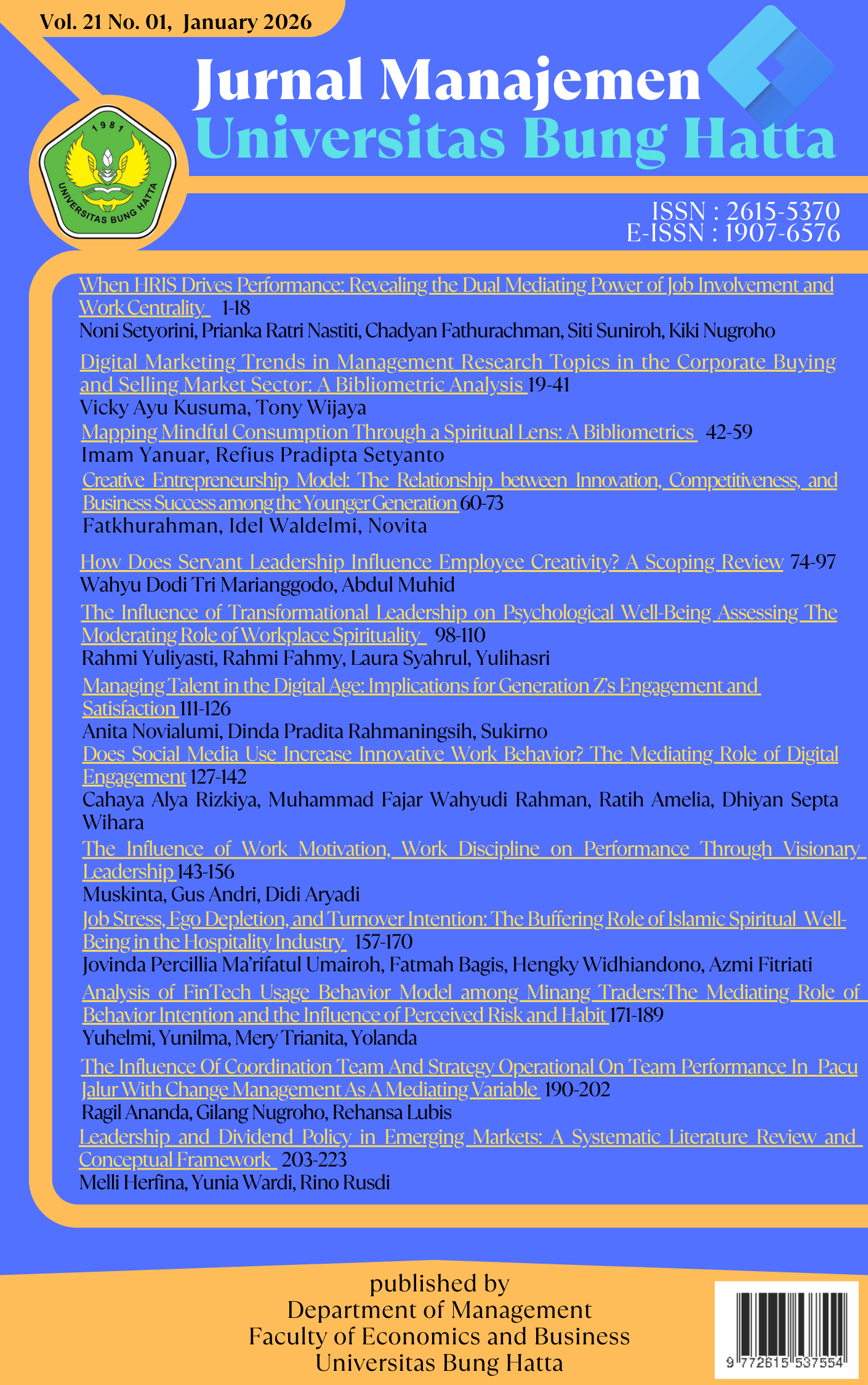
When HRIS Drives Performance: Revealing the Dual Mediating Power of Job Involvement and Work Centrality
DOI:
https://doi.org/10.37301/jmubh.v21i1.29280Keywords:
HRIS; job involvement; work centrality; job performanceAbstract
Organizations are increasingly adopting Human Resource Information Systems (HRIS) to enhance HRM effectiveness and strengthen employee performance in digitally driven work environments. This study examines the effects of HRIS on job involvement, work centrality, and employee performance, while also evaluating the dual mediating roles of job involvement and work centrality. Data were collected from 200 employees selected through nonprobability sampling, targeting individuals with direct experience using HRIS. The measurement and structural models were analyzed using SmartPLS 4. The results indicate that HRIS significantly enhances job involvement, work centrality, and employee performance. Job involvement also shows a positive influence on performance, whereas work centrality does not exhibit a significant direct effect. Mediation analysis further reveals that job involvement significantly mediates the relationship between HRIS and employee performance, while work centrality does not. These findings suggest that HRIS improves employee performance primarily by fostering higher involvement rather than by strengthening work centrality. This study contributes to the literature by clarifying the psychological mechanisms through which digital HR systems influence employee outcomes and offers practical implications for organizations seeking to optimize HRIS utilization to enhance workforce performance.
References
Al Obaidly, A. A. A., Al Samman, A. M. A., & Hameed Aldulaimi, S. H. (2022). Electronic Human Resource Management and How it Affects Employee Performance. Journal of Statistics Applications and Probability, 11, 211–232. https://doi.org/10.18576/jsap/11S113
Al Samman, A. M. A., & Obaidly, A. A. A. A. (2024). AI-Driven e-HRM Strategies: Transforming Employee Performance and Organizational Productivity. 23–29. https://doi.org/10.1109/ICETSIS61505.2024.10459398
Aldmour, R. H. (2020). The Influence of hris usage on employee performance and mediating effects of employee engagement in five stars hotels in jordan. International Journal of Information Systems in the Service Sector, 12(3), 1–18. https://doi.org/10.4018/IJISSS.2020070101
Al-Kasasbeh, A. M., Halim, M. A. S. A., & Omar, K. (2016). E-HRM, workforce agility and organizational performance: A review paper toward theoretical framework. International Journal of Applied Business and Economic Research, 14(15), 10671–10685. https://www.scopus.com/inward/record.uri?eid=2-s2.0-85013960481&partnerID=40&md5=e29c9e50820a24703e9935a6b32eaf9e
Alomari, A. M. (2023). Exploring the impact of e-HRM on organizational performance: A mediated model. International Journal of Data and Network Science, 7(4), 1913–1920. https://doi.org/10.5267/j.ijdns.2023.7.002
Alrawashdeh, N. M. A. A., Zaki, N. A. M., Nik Mat, N. H. B. N., Yusof, J. B. M., & Zulkiffli, S. N. (2024). Impact of Electronic Human Resource Management Practices on Perceived Organization Performance: Moderating Role of Information Technology Capability on Jordanian Universities. Pakistan Journal of Life and Social Sciences, 22(1), 6509–6527. https://doi.org/10.57239/PJLSS-2024-22.1.00477
Alrawashdeh, N. M. A. A., Zaki, N. A. M., Yusof, J. B. M., & Nik Mat, N. H. B. N. (2022). Electronic Human Resource Management Practices, Information Technology Capability and Organisational Performance: A Review Paper Toward Conceptual Framework. Journal of Advanced Research in Applied Sciences and Engineering Technology, 28(2), 148–161. https://doi.org/10.37934/araset.28.2.148161
Ammupriya, A., & Preetha, P. (2023). Enhancement of work engagement through HRIS adoption mediated by workplace well-being. Brazilian Journal of Operations and Production Management, 20(1). https://doi.org/10.14488/BJOPM.1499.2023
Begum, H., Bhuiyan, F., Ferdous Alam, A. S. A., Awang, A. H., Masud, M. M., & Akhtar, R. (2020). Cost reduction and productivity improvement through HRIS. International Journal of Innovation and Sustainable Development, 14(2), 185–198. https://doi.org/10.1504/IJISD.2020.106235
Chabani, Z. (2020). THE CHALLENGES FACING PUBLIC ORGANIZATIONS TO IMPLEMENT HUMAN RESOURCES INFORMATION SYSTEMS: A CASE STUDY OF ALGERIA. Journal of Management Information and Decision Science, 23(4), 230–244. https://www.scopus.com/inward/record.uri?eid=2-s2.0-85109839980&partnerID=40&md5=3b902faefa4dcb6edde942e9f1b448db
Chanana, C., Ahmad, S., Kumar, S., Kumari, N., & Ahmad, R. (2025). Antecedents of environmental sustainability based on E-HRM approach: An empirical investigation. Green Technologies and Sustainability, 3(3). https://doi.org/10.1016/j.grets.2025.100175
Dagnes, J., & Storti, L. (2025). Escape from Work? Distinctions within the Realm of Anti-Work. Sociologia Del Lavoro, (171), 9–32. https://doi.org/10.3280/SL2025-171001
Geldenhuys, M., Bakker, A. B., & Demerouti, E. (2021). How task, relational and cognitive crafting relate to job performance: a weekly diary study on the role of meaningfulness. European Journal of Work and Organizational Psychology, 30(1), 83–94. https://doi.org/10.1080/1359432X.2020.1825378
Gupta, P. K., & Mittal, P. (2025). Perceptual issues of HRIS adoption – evidence from Indian companies. International Journal of Business Information Systems, 48(2), 248–266. https://doi.org/10.1504/IJBIS.2025.144385
Haller, M., Klösch, B., & Hadler, M. (2023). The Centrality of Work: A Comparative Analysis of Work Commitment and Work Orientation in Present-Day Societies. SAGE Open, 13(3). https://doi.org/10.1177/21582440231192114
Hu, S., Jiang, L., Probst, T. M., & Liu, M. (2021). The relationship between qualitative job insecurity and subjective well-being in Chinese employees: The role of work–family conflict and work centrality. Economic and Industrial Democracy, 42(2), 203–225. https://doi.org/10.1177/0143831X18759793
Iqbal, N., Ahmad, M., & M.C. Allen, M. M. C. (2019). Unveiling the relationship between e-HRM, impersonal trust and employee productivity. Management Research Review, 42(7), 879–899. https://doi.org/10.1108/MRR-02-2018-0094
Jiang, L., & Johnson, M. S. (2018). Meaningful Work and Affective Commitment: A Moderated Mediation Model of Positive Work Reflection and Work Centrality. Journal of Business and Psychology, 33(4), 545–558. https://doi.org/10.1007/s10869-017-9509-6
John, A. P., & Velmurugan, V. P. (2024). Optimizing employee performance through E-HRM: Insights from its organizations in Trivandrum. Edelweiss Applied Science and Technology, 8(6), 5606–5617. https://doi.org/10.55214/25768484.v8i6.3233
Johnson, R. D., Stone, D. L., & Lukaszewski, K. M. (2020). The benefits of eHRM and AI for talent acquisition. Journal of Tourism Futures, 7(1), 40–52. https://doi.org/10.1108/JTF-02-2020-0013
Joseph F. Hair, Jr. ; G. T. M. H. C. M. R. M. S. (2021). A primer on partial least squares structural equation modeling (PLS-SEM)-Third Edition.
Joseph. Hair, William C. Black, Barry J. Babin, R. E. A. (2006). Multivariate_Data_Analysis_7th_Edition.pdf (pp. 1–761).
Kooij, D. T. A. M., & Zacher, H. (n.d.). Why and When Do Learning Goal Orientation and Attitude Decrease with Age? The Role of Perceived Remaining Time and Work Centrality. 1–36.
Kundi, Y. M., Aboramadan, M., Elhamalawi, E. M. I., & Shahid, S. (2021). Employee psychological well-being and job performance: exploring mediating and moderating mechanisms. International Journal of Organizational Analysis, 29(3), 736–754. https://doi.org/10.1108/IJOA-05-2020-2204
Lopes, H. (2023). The Centrality of Work: A Foundation for Political Economy. Review of Political Economy, 35(2), 494–509. https://doi.org/10.1080/09538259.2021.1958540
Maamari, B. E., & Osta, A. (2021). The effect of HRIS implementation success on job involvement, job satisfaction and work engagement in SMEs. International Journal of Organizational Analysis, 29(5), 1269–1286. https://doi.org/10.1108/IJOA-07-2020-2298
Machado, C., & Guedes, P. A. M. (2015). e-HRM: A reality or just virtual? A glance about its relevance and implications (pp. 157–169). Nova Science Publishers, Inc. https://www.scopus.com/inward/record.uri?eid=2-s2.0-84956654448&partnerID=40&md5=72cd88a6652e9d5b03e1c9f9533dcc39
Malhotra, N., Sahadev, S., & Sharom, N. Q. (2022). Organisational justice, organisational identification and job involvement: the mediating role of psychological need satisfaction and the moderating role of person-organisation fit. International Journal of Human Resource Management, 33(8), 1526–1561. https://doi.org/10.1080/09585192.2020.1757737
Nasar, N., Ray, S., Wadud, A., & Umer, S. (2022). Prediction Model for Talent Management Analysis Through e-HRM. In A. Sachdeva, P. Kumar, O. P. Yadav, & M. Tyagi (Eds.), Lecture Notes in Mechanical Engineering (pp. 193–207). Springer Science and Business Media Deutschland GmbH. https://doi.org/10.1007/978-981-16-7059-6_16
Škudiene, V., Vezeliene, G., & Štangej, O. (2020). Transforming human resource management:innovative e-HRM value creation for multinational companies (pp. 140–166). Edward Elgar Publishing Ltd. https://doi.org/10.4337/9781789909814.00021
Tang, W. G., & Vandenberghe, C. (2021). Role Overload and Work Performance: The Role of Psychological Strain and Leader–Member Exchange. Frontiers in Psychology, 12(May), 1–14. https://doi.org/10.3389/fpsyg.2021.691207
Uçanok Tan, B. (2023). Effects of Materialist Values and Work Centrality on Organizational Citizenship Behaviors. SAGE Open, 13(4). https://doi.org/10.1177/21582440231214466
Vadithe, R. N., Nenavath, N., Kesari, B., Chiranjeevi, V., Mudavath, C. B. N., & Rajput, R. C. (2025). The role of HR analytics in driving organizational agility and operational performance: evidence from the construction sector. Engineering, Construction and Architectural Management. https://doi.org/10.1108/ECAM-01-2025-0076
Valcik, N. A., Sabharwal, M., & Benavides, T. J. (2021a). Existing Research on HRIS in Public Organizations. In Management for Professionals: Part F470 (pp. 33–45). Springer Nature. https://doi.org/10.1007/978-3-030-75111-1_3
Valcik, N. A., Sabharwal, M., & Benavides, T. J. (2021b). Obstacles for Public Organizations Using HRIS. In Management for Professionals: Part F470 (pp. 125–143). Springer Nature. https://doi.org/10.1007/978-3-030-75111-1_9
Volery, T., & Tarabashkina, L. (2021). The impact of organisational support, employee creativity and work centrality on innovative work behaviour. Journal of Business Research, 129, 295–303. https://doi.org/10.1016/j.jbusres.2021.02.049
Yahui, S., & Jian, Z. (2015). Does work passion promote work performance? From the perspective of Dualistic Model of Passion. Advances in Management Accounting, 8(2), 9–15. https://www.scopus.com/inward/record.uri?eid=2-s2.0-84923875872&partnerID=40&md5=d4ca706e7d4ee88c154b01285984604e
Yeh, C. M. (2021). The relationship between free time activities, emotional intelligence and job involvement of frontline hotel employees. International Journal of Human Resource Management, 32(4), 767–788. https://doi.org/10.1080/09585192.2018.1496127
Downloads
Published
Issue
Section
License
Copyright (c) 2026 Noni Setyorini, Prianka Nastiti, Chadyan Fathurachman, Siti Suniroh, Kiki Nugroho

This work is licensed under a Creative Commons Attribution-ShareAlike 4.0 International License.
Authors who publish with Jurnal Manajemen Universitas Bung Hatta agree to the following terms:
- Authors retain copyright and grant the journal right of first publication with the work simultaneously licensed under a Creative Creative Commons Attribution-ShareAlike 4.0 International License that allows others to share the work with an acknowledgement of the work's authorship and initial publication in Jurnal Manajemen Universitas Bung Hatta.
- The author holds the copyright of the submitted and published articles, with the understanding that articles are disseminated under the Creative Commons Attribution-ShareAlike 4.0 International License..
- The editor team is entitled to do the editing in accordance with the guidelines for writing or template in the Jurnal Manajemen Universitas Bung Hatta.
This work is licensed under a Creative Commons Attribution-ShareAlike 4.0 International License.