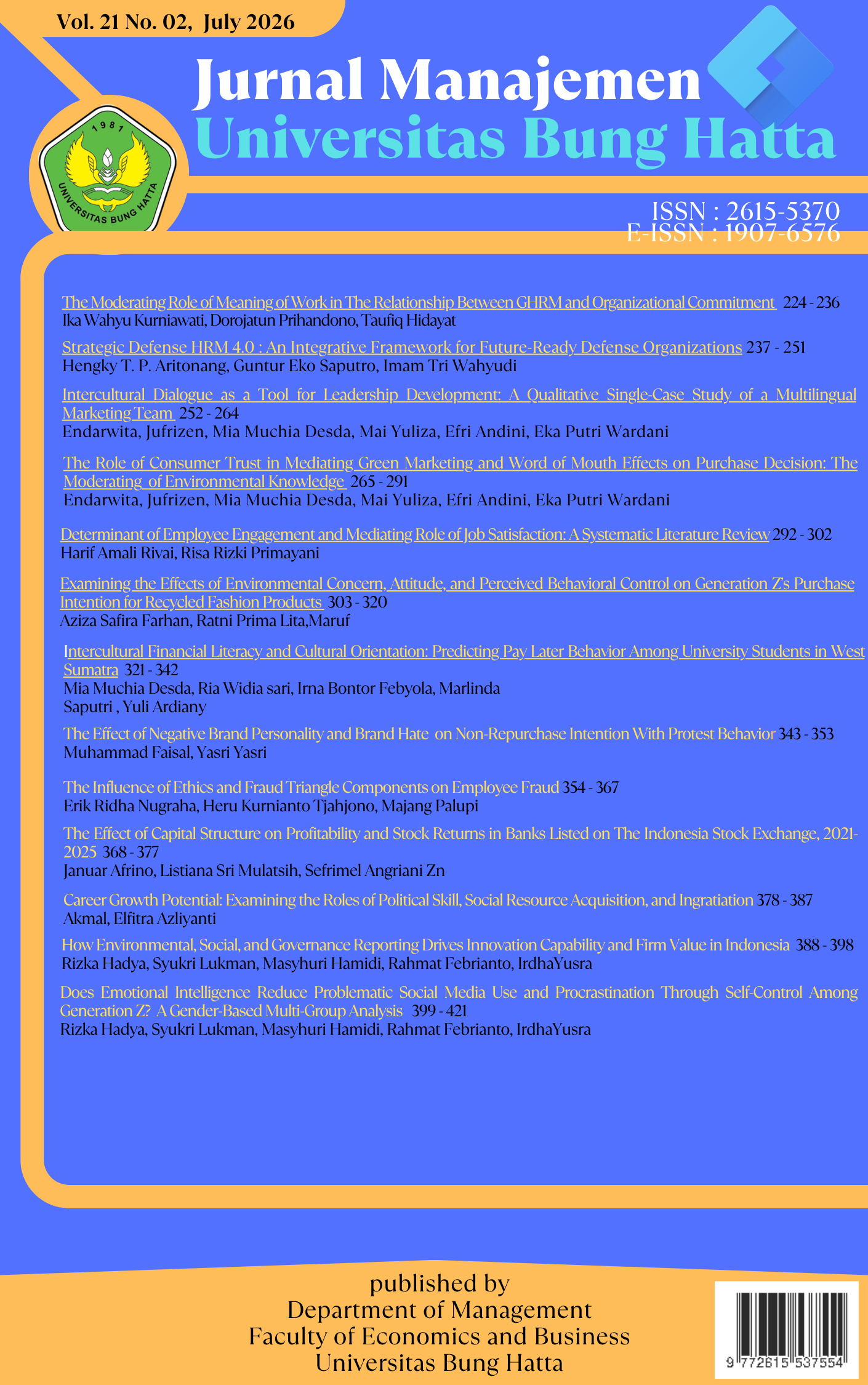
Intercultural Financial Literacy and Cultural Orientation: Predicting Pay Later Behavior Among University Students in West Sumatra
DOI:
https://doi.org/10.37301/jmubh.v21i2.30009Keywords:
intercultural financial literacy, financial attitude, risk perception, cultural orientation, Pay Later behaviorAbstract
The development of the digital economy has given rise to the phenomenon of Buy Now, Pay Later (BNPL), which is popular among students but poses risks of consumptive behavior and unhealthy debt management due to low financial literacy and cultural awareness. This study aims to develop and test the Intercultural Financial Literacy (IFL) model as a new construct that combines financial literacy and cross-cultural awareness in explaining Pay Later usage behavior among students in West Sumatra. Using an explanatory quantitative approach with 300 respondents and Structural Equation Modeling-Partial Least Squares (SEM-PLS) analysis, the results show that IFL significantly influences financial attitudes and risk perceptions, which indirectly affect Pay Later behavior, while cultural orientation positively moderates this relationship. The research model explains 61.1% of the variation in digital financial behavior (R²=0.611) with good construct validity and reliability. These findings confirm that cross-cultural financial literacy is an important competency for the younger generation to shape ethical, responsible, and sustainable financial behavior in the pay later economy era.
References
Ajzen, I. (1991). The theory of planned behavior. Organizational Behavior and Human Decision Processes, 50(2), 179–211. https://doi.org/10.1016/0749-5978(91)90020-T
Ang, S., Van Dyne, L., Koh, C., Ng, K. Y., Templer, K. J., Tay, C., S Chandrasekar, N. A. (2007). Cultural intelligence: Its measurement and effects on cultural judgment and decision making, cultural adaptation and task performance. Management and Organization Review, 3(3), 335–371.
Atkinson, A., S Messy, A. F. (2012). Measuring Financial Literacy: Results of the OECD / International Network on Financial Education (INFE) Pilot Study (OECD Working Papers on Finance, Insurance and Private Pensions No. 15; OECD Working Papers on Finance, Insurance and Private Pensions, Vol. 15). https://doi.org/10.1787/5k9csfs90fr4-en
Bialowolski, P., Xiao, J. J., S Weziak-Bialowolska, D. (2023). National Culture and Financial Capability: A Global Perspective. Social Indicators Research, 170(3), 877–891. https://doi.org/10.1007/s11205-023-03221-7
Brown, M., Henchoz, C., S Spycher, T. (2018). Culture and financial literacy: Evidence from a within-country language border. Journal of Economic Behavior & Organization, 150, 62–85. https://doi.org/10.1016/j.jebo.2018.03.011
Center, K. I. (2024). Laporan perilaku pengguna PayLater Indonesia 2024. Katadata Insight Center. https://databoks.katadata.co.id/publikasi/2024/06/25/laporan-perilaku-pengguna-paylater-indonesia-2024
Coskun, A., S Dalziel, N. (2020). Mediation effect of financial attitude on financial knowledge and financial behavior: The case of university students. International Journal of Research in Business and Social Science, 9(2), 1–8.
De Beckker, K., De Witte, K., S Van Campenhout, G. (2020). The role of national culture in financial literacy: Cross-country evidence. Journal of Consumer Affairs, 54(3), 748–775. https://doi.org/10.1111/joca.12307
Elfira, M. (2023). Minangkabau mothers and daughters in contemporary" rantau" society; Regaining power with modified matrilineal principles and patriarchal" rantau" norms. Wacana, Journal of the Humanities of Indonesia, 24(2), 1.
Faulkner, J., S Mesías, F. (2022). Financial literacy and inclusion: A cross-country comparison of national strategies. Journal of Behavioral and Experimental Finance, 36, 100713. https://doi.org/10.1016/j.jbef.2022.100713
Filotto, U., Salerno, D., Sampagnaro, G., S Stella, G. P. (2024). Riding the wave of change: Buy now, pay later as a disruptive threat to payment cards in the global market. Research in International Business and Finance, 72. Scopus. https://doi.org/10.1016/j.ribaf.2024.102499
Firdaus, R., S Soma, A. M. (2025). The influence of performance expectancy, effort expectancy, social influence, facilitating conditions, and financial literacy on use behavior of Buy Now Pay Later services with behavior intention as a mediating variable among Generation Z in the Bandung Raya area. 6(3), 281–286.
Gaju, A. (2025). Buy now, pay later: Drivers and challenges in increasing adoption. World Conference on Management, Business, and Economics. https://doi.org/https://doi.org/10.33422/worldmbe.v1i1.995
Gudmunson, C. G., S Danes, S. M. (2011). Family financial socialization: Theory and critical review. Journal of Family and Economic Issues, 32(4), 644–667. https://doi.org/10.1007/s10834-011-9275-y
Hair, J. F., Risher, J. J., Sarstedt, M., S Ringle, C. M. (2019). When to use and how to report the results of PLS-SEM. European Business Review, 31(1), 2–24. https://doi.org/10.1108/EBR-11-2018-0203
Indonesia, B. (2025). Monetary policy report: Quarter IV 2024. Bank Indonesia. https://www.bi.go.id/en/publikasi/laporan/Pages/Laporan-Kebijakan-Moneter-Triwulan-IV-2024.aspx
Irene, B., Ndlovu, E., Felix-Faure, P. C., Dlabatshana, Z., S Ogunmokun, O. (2025). The Role of Financial Institutions in Bridging the Financing Gap for Women Entrepreneurs in Sub-Saharan Africa. Administrative Sciences, 15(8). Scopus. https://doi.org/10.3390/admsci15080323
Juita, V., Pujani, V., Rahim, R., S Rahayu, R. (2024). The influence of user’s digital financial literacy and perceived risks on buy now pay later (BNPL) adoption: A gender’s perspective. International Conference on Entrepreneurship, Leadership and Business Innovation (ICELBI 2022), 629–645.
OECD. (2025). Global report on financial literacy and financial inclusion 2025. OECD Publishing. https://www.oecd.org/finance/financial-education
OECD, O. (2022). OECD/INFE toolkit for measuring financial literacy and financial inclusion 2022. OECD Publishing.
OJK. (2024). Siaran pers bersama: OJK dan BPS umumkan hasil Survei Nasional Literasi dan Inklusi Keuangan Tahun 2024. Otoritas Jasa Keuangan. ttps://ojk.go.id/id/berita-dan-kegiatan/siaran-pers/Documents/Pages/OJK-dan-BPS-Umumkan-Hasil-Survei-Nasional-Literasi-dan-Inklusi-Keuan gan -Tahun -2024/SP%20OJK%20dan%20BPS%20Umumkan%20Hasil%20Survei%20Nasional%20Litera si%20dan%20Inklusi%20Keuangan%20Tahun%202024.pdf
Raj, V. A., Jasrotia, S. S., S Rai, S. S. (2025). Role of perceived risks and perceived benefits on consumers behavioural intention to use Buy-Now, Pay-Later (BNPL) services. Journal of Facilities Management, 23(2), 330–351.
Retnaningrum, K., S Sundari, S. (2025). The effect of financial literacy, financial attitude, and perceived risk on financial management behavior in using Buy Now Pay Later (BNPL). 7(2), 234–249.
Rodríguez-Correa, C., Sánchez, F., S Pérez, A. (2025). Financial literacy among young generations: Essential skills for future financial responsibility. PLOS ONE, 20(2), e0299835. https://doi.org/10.1371/journal.pone.0299835
Rogers, E. M. (2003). Diffusion of Innovations (5th ed.). Free Press.
Sukmawati, E. (2019). Filosofi sistem kekerabatan matrilineal sebagai perlindungan sosial keluarga pada masyarakat Minangkabau. EMPATI: Jurnal Ilmu Kesejahteraan Sosial, 8(1), 12–26.
Thomas, R., Ramadhanti, A., S Indriaty, S. (2024). Financial literacy, social capital, and fintech adoption among Indonesian students. https://doi.org/10.48550/arXiv.2405.06570
Tyagi, A., Gupta, P., S Arora, N. (2025). Determinants of Buy Now Pay Later service adoption: A configurational approach. SSRN Electronic Journal. https://doi.org/10.2139/ssrn.4715290
World Bank. (2024). Global fintech report: Pay later economic growth in developing countries. The World Bank Group. https://documents.worldbank.org
World Bank Group Annual Report 2025. (n.d.).
Yoo, B., Donthu, N., S Lenartowicz, T. (2011). Measuring Hofstede’s five dimensions of cultural values at the individual level: Development and validation of CVSCALE. Journal of International Consumer Marketing, 23(3–4), 193–210.
Zhang, C. (2024). Digital governance leveraging urbanization and fintech synergies for sustainable development in BRICS. Scientific Reports, 14(1). Scopus. https://doi.org/10.1038/s41598-024-81712-4
Downloads
Published
Issue
Section
License
Copyright (c) 2026 Mia Muchia Desda, Ria Widia sari, Irna Bontor Febyola, Marlinda Saputri, Yuli Ardiany

This work is licensed under a Creative Commons Attribution-ShareAlike 4.0 International License.
Authors who publish with Jurnal Manajemen Universitas Bung Hatta agree to the following terms:
- Authors retain copyright and grant the journal right of first publication with the work simultaneously licensed under a Creative Creative Commons Attribution-ShareAlike 4.0 International License that allows others to share the work with an acknowledgement of the work's authorship and initial publication in Jurnal Manajemen Universitas Bung Hatta.
- The author holds the copyright of the submitted and published articles, with the understanding that articles are disseminated under the Creative Commons Attribution-ShareAlike 4.0 International License..
- The editor team is entitled to do the editing in accordance with the guidelines for writing or template in the Jurnal Manajemen Universitas Bung Hatta.
This work is licensed under a Creative Commons Attribution-ShareAlike 4.0 International License.